Collagen vs. Retinol: Which One Actually Plumps Menopausal Skin?
Published January 7, 2026 • 5 min read
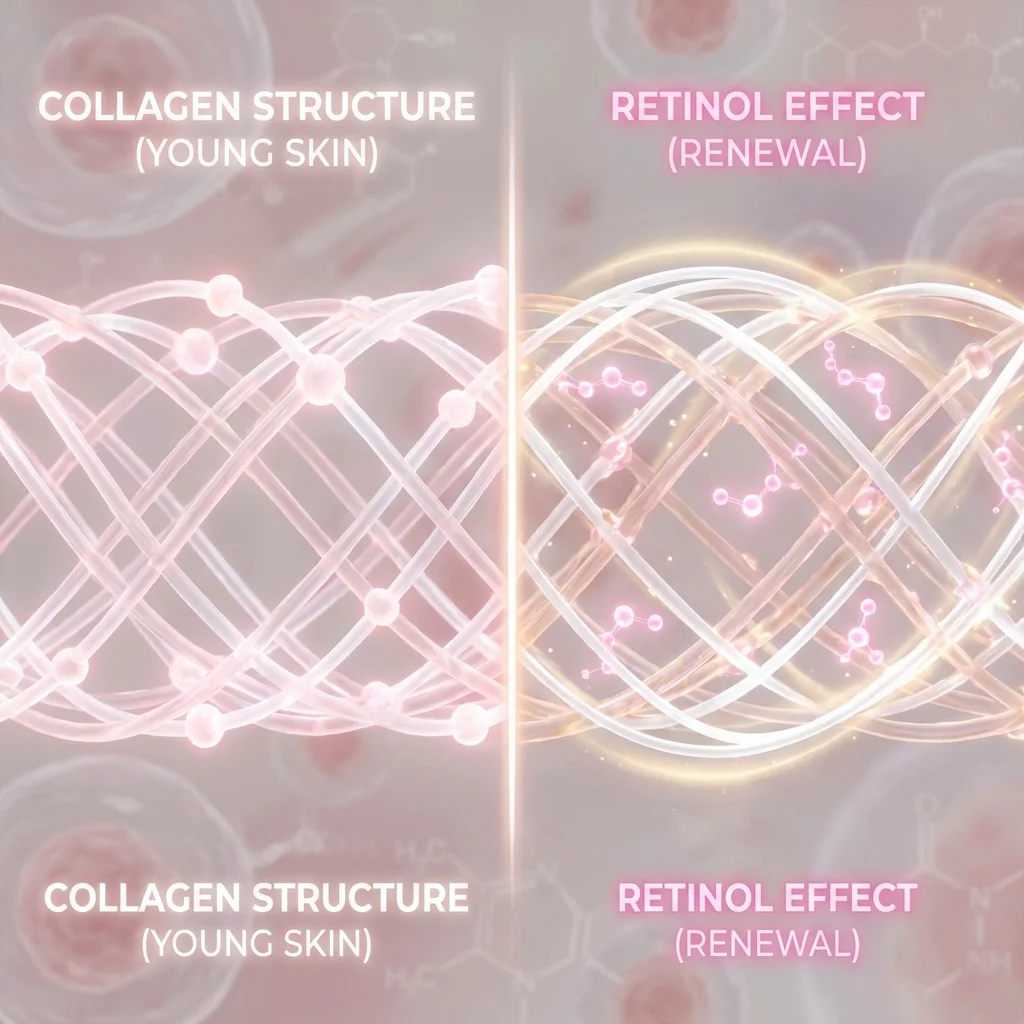
It’s the question every woman asks her dermatologist once she hits 45: "If I can only buy one expensive serum, should it be Collagen or Retinol?" The answer isn't as simple as picking a favorite. It depends entirely on whether your skin is suffering from sagging or dullness. And during menopause, it's usually both.
The Great Estrogen Drop
Before we dive into the battle of the ingredients, we need to talk about the elephant in the room: Estrogen. This hormone is practically a fountain of youth for your skin. It stimulates oil production (keeping you dewy), holds onto water (keeping you plump), and most importantly, tells your fibroblasts to produce collagen.
When menopause hits—or even during the decade of perimenopause preceding it—estrogen levels plummet. Studies show that women lose up to 30% of their skin's collagen in the first five years of menopause alone. That is a staggering statistic. This isn't just "aging"; this is a structural collapse of the mattress underneath your skin.
Collagen: The Mattress Springs
Think of your skin like a mattress. Collagen fibers are the springs that hold it up and give it bounce. When those springs rust or break (due to age and UV damage), the mattress sags. That's gravity taking over.
The Problem with Topical Collagen: Here is the hard truth that most skincare brands won't tell you: Collagen molecules are huge. Trying to push a collagen molecule into your skin is like trying to push a beach ball through a chain-link fence. It just sits on top. It feels nice and moisturizing, but it doesn't actually add structural support.
The Solution: You need to rebuild collagen from the inside out. Ingestible collagen peptides are hydrolyzed (broken down) into tiny amino acid chains that your body can actually absorb. Once in your bloodstream, they travel to the skin and signal your body to start knitting new "springs." This is why we seeing such incredible results with high-quality oral supplements like Hydrossential.
Retinol: The Surface Polisher
If Collagen is the mattress springs, Retinol (Vitamin A) is the silk sheet on top. It doesn't necessarily hold the mattress up, but it makes the surface incredibly smooth, tight, and glowing.
Retinol works by speeding up cellular turnover. As we age, our dead skin cells get sticky and hang around longer, making us look grey and tired. Retinol kicks those lazy cells off, revealing the fresh, pink baby skin underneath. It also helps with the pigmentation spots that seem to appear out of nowhere in our 40s.
The Verdict: You Need Both
So, who wins the battle? Neither. They are teammates playing different positions.
- Use Retinol Topically: Apply a high-quality, hydrating retinol serum at night to polish the surface, erase fine lines, and fade age spots.
- Take Collagen Internally: Don't waste money on collagen creams. Drink or eat your collagen peptides to rebuild the structural volume and "bounce" that estrogen used to protect.
This "Inside-Outside" approach constitutes the only way to truly counteract the effects of hormonal aging. You cannot fix a structural problem (collagen loss) with surface paint (creams), and you cannot fix a surface problem (dullness) with structural beams.
Restore Your Skin's Structural Integrity
Ready to rebuild your collagen from within? Hydrossential is formulated specifically to maintain flawless skin support during hormonal shifts.
Discover Hydrossential